

Corrective Actions Not Working? Why the Same Problem Comes Back
Corrective actions not working does not automatically mean the action itself was poorly chosen. A recurring problem can result from an incomplete causal explanation, an action that was not strong enough for the identified cause, weak implementation, or an effectiveness check that confirmed completion rather than confirming that the problem had actually been controlled.
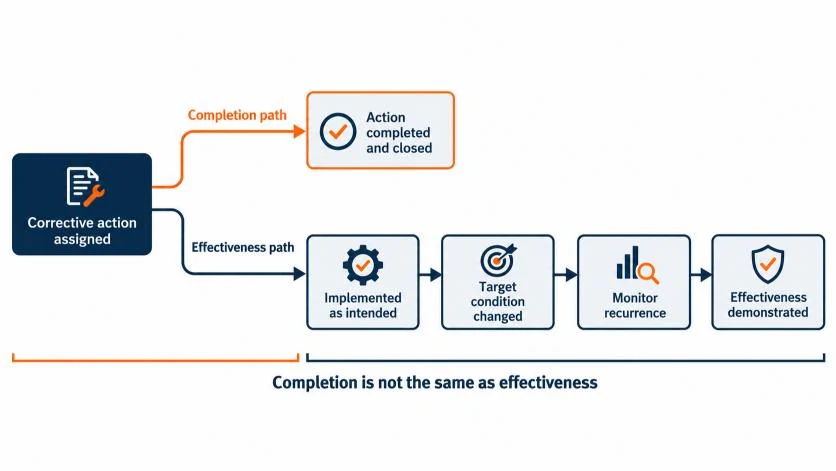
The core distinction is simple: an action can be completed and closed while the condition that produced the problem remains unchanged.
When a problem returns, the most useful response is usually to revisit the logic behind the original investigation before issuing the next obvious action.
Corrective Actions Not Working? Start by Separating Completion From Effectiveness
Many maintenance and reliability systems are very good at tracking whether an action has an owner, a due date and a closed status. Those controls are useful, but they answer an administrative question: did we do what we said we would do?
Corrective action effectiveness asks a different question: did the action change the condition that allowed the problem to occur?
Corrective action guidance consistently separates cause determination, action implementation and effectiveness verification. A closed action therefore tells you that the task was completed, not that the original problem was prevented from recurring.
In practice, when managers ask why the problem happened again after every action was completed, a good starting point is to go back to the original cause chart or causal logic and test it again. If the logic still holds, the weakness may sit in the solution criteria or implementation. If it does not, the recurrence may be telling you that a cause was missed or that the apparent repeat failure actually occurred through a different failure mode.
This distinction matters because a repeat failure after corrective action can look identical at the equipment level while having a different causal path. Oil contamination and bearing overload, for example, may both present as a failed bearing, but the corrective actions needed to prevent recurrence are very different.
The First Failure Can Happen Before the Corrective Action Is Written
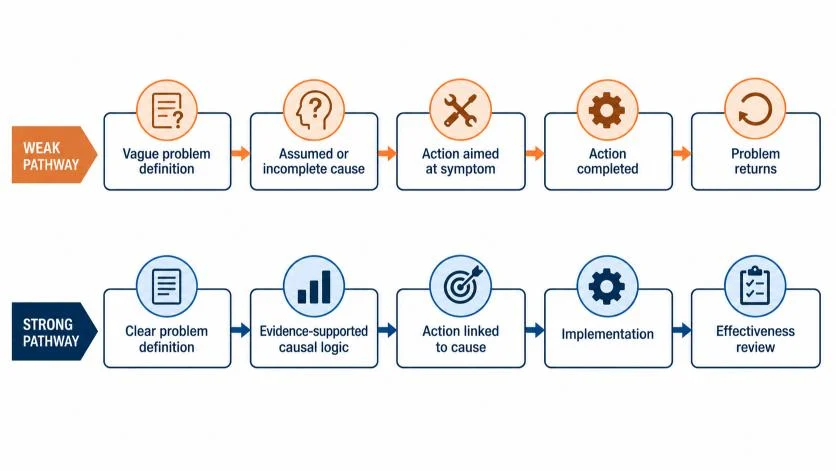
A corrective action can only be as good as the problem definition and causal logic that produced it. If the problem is vaguely defined, the investigation may drift toward symptoms, assumptions or convenient explanations rather than identifying the conditions that actually produced the event.
A plausible cause is still only a hypothesis until it is supported by evidence. If the causal model is incomplete, the team may develop an action that addresses one contributor while leaving another necessary condition unchanged.
We have seen this on underground mining equipment where repeated failures of automated ladder motors were initially treated as a component problem. The available information suggested the motors had shorted out, so a more robust motor was selected and installed. The replacement was implemented properly, yet consumption of the new motors continued at essentially the same rate.
The investigation was then taken further. Failed motors were recovered and physically dismantled, which showed that water ingress was the real issue. The motor itself was fit for purpose. The effective response was to improve the casing and sealed protective environment around the motor rather than continue upgrading the component.
The lesson is not that component replacement is a weak action. It is that the action was based on an incomplete causal explanation. Once the evidence changed the understanding of the failure, the corrective action could be redirected toward the condition that was actually producing it.
A Good Action Must Be Linked to a Supported Cause
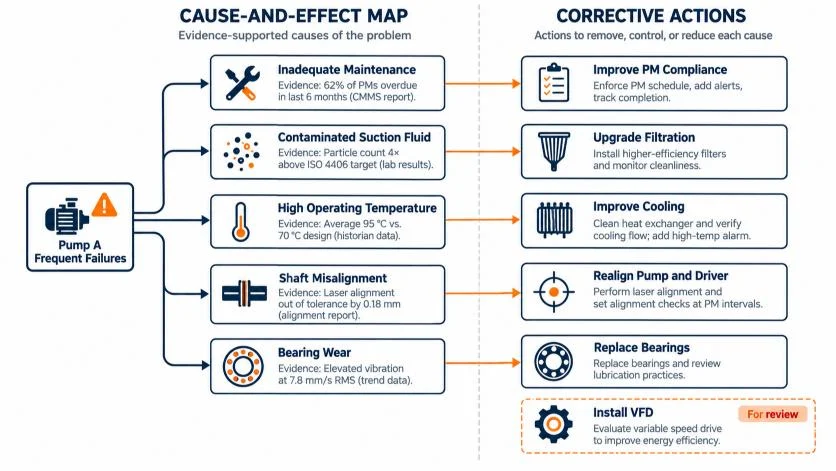
A useful test for any proposed action is to ask: which identified cause is this action intended to remove, control or reduce?
If that relationship cannot be explained clearly, the action deserves more scrutiny. Generic actions such as retraining, revising a procedure, increasing inspection frequency or replacing a component can all be valid, but only where they address a causal condition supported by the investigation.
This is the heart of root cause corrective action. The quality of the action depends on whether there is a defensible connection between the cause and the change being proposed.
The strength of the control should also reflect the consequence and failure mechanism. A reminder or procedure update may be suitable where the problem genuinely resulted from a knowledge or process gap. The same response will be weak if the real issue is a design limitation, operating condition, environmental exposure or component interaction.
Before accepting the action, also check whether it could create new risks or shift the problem somewhere else. Solving one failure mode by introducing another is not an effective outcome.
The Right Corrective Action Can Still Fail During Implementation
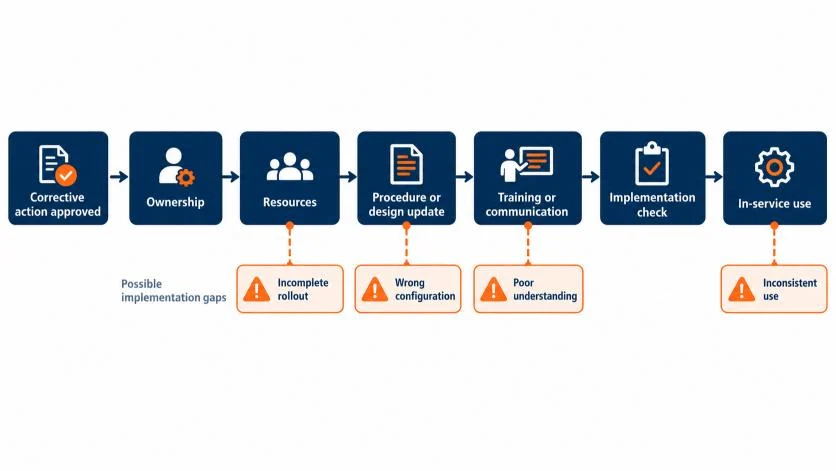
Even when the causal logic is sound and the proposed action is appropriate, implementation can still undermine the result.
A procedure can be revised without the people doing the work understanding why the change matters. A design modification can be approved but applied inconsistently across the fleet. Training can be delivered without changing the task environment, supervision or controls that influence how the work is actually performed.
Ownership is often part of this. If a group of managers and technical specialists develops a solution and then simply hands it to a maintenance team to execute, the people carrying out the change may understand the instruction without understanding the problem it is intended to control. That makes it easier for implementation to become a compliance exercise rather than a genuine change to the way the failure is managed.
Implementation therefore needs more than a due date. It needs clear ownership, adequate resources, communication, confirmation that the change was made as intended, and enough follow-up to show that it has become part of normal work.
Completed Is Not the Same as Effective
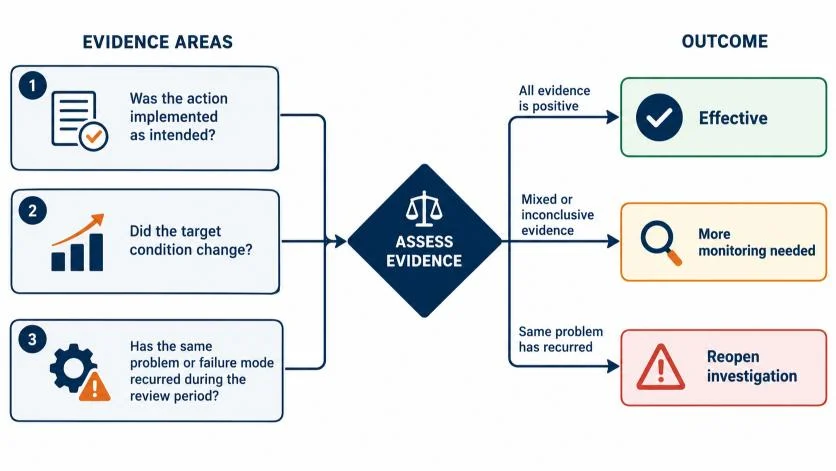
An effective corrective action process defines what success will look like before the action is closed.
The measure should relate back to the original problem. If the issue was repeated motor failure, the useful question is not simply whether the new enclosure was installed. The useful questions are whether water ingress has been controlled, whether the failure mode has stopped or reduced, and whether any new adverse effects have appeared.
A practical effectiveness review should consider:
- Was the action implemented as intended?
- Did it address the problem it was designed to solve?
- Did it introduce any unintended consequences or new risks?
- Was it within the organisation’s control, budget and operating constraints?
- Has enough time or operating exposure passed to judge whether the result is sustained?
The review period should suit the failure frequency and process cycle. A problem that previously occurred every few days can be assessed relatively quickly. A failure that occurs only every few months needs a longer observation period before the organisation can reasonably claim that the corrective action was effective.
This is why corrective action closure should not be treated as proof of success. Closure is an administrative state. Effectiveness requires evidence that the target condition changed and that the recurrence risk has actually been controlled.
If your organisation is moving from a one-off event into a pattern of recurring problems, the Practical RCA Toolkit provides checklists and worksheets to help review investigation readiness, evidence, actions and effectiveness before the next response is selected.
Treat Recurrence as New Evidence, Not Just Another Failure
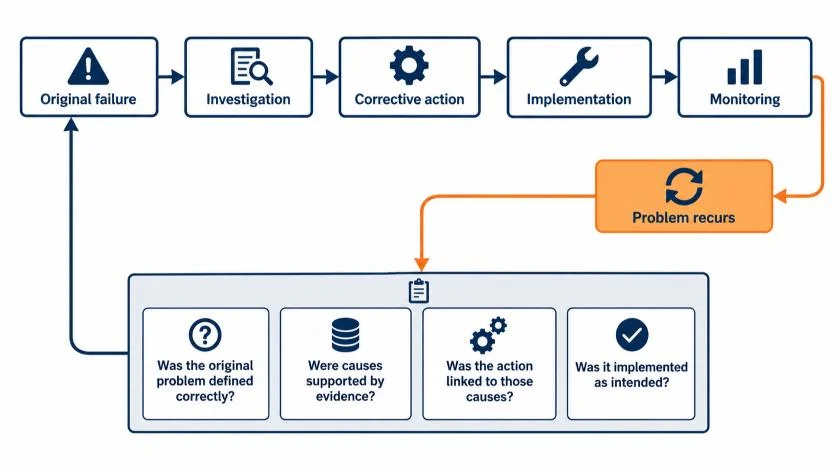
When the same problem comes back, there is a natural tendency to move quickly to the next solution. By this point the reliability metrics may be deteriorating, operations may be applying pressure, and the team wants the issue fixed.
The better response is to treat recurrence as new evidence.
Go back to the previous investigation and ask:
- Did the failure happen in the same way as before?
- Is the original problem definition still accurate?
- Does the previous causal logic still hold?
- Was the corrective action fully implemented and sustained?
- Did the action satisfy the effectiveness criteria that were originally set?
- Has the new event exposed an additional condition or a different failure mode?
This is particularly important because maintenance teams often deal with events individually. Once an action is closed, the earlier investigation may fade into the background and the next event is treated as a new job. Looking across the sequence of failures can reveal whether the organisation is dealing with one unresolved recurring problem or several different failure modes that happen to produce a similar symptom.
If this pattern is familiar, the related guide on what to do when the same equipment keeps failing explains how to separate the asset symptom from the underlying failure pattern.
When a Failed Corrective Action Should Trigger a Fresh RCA
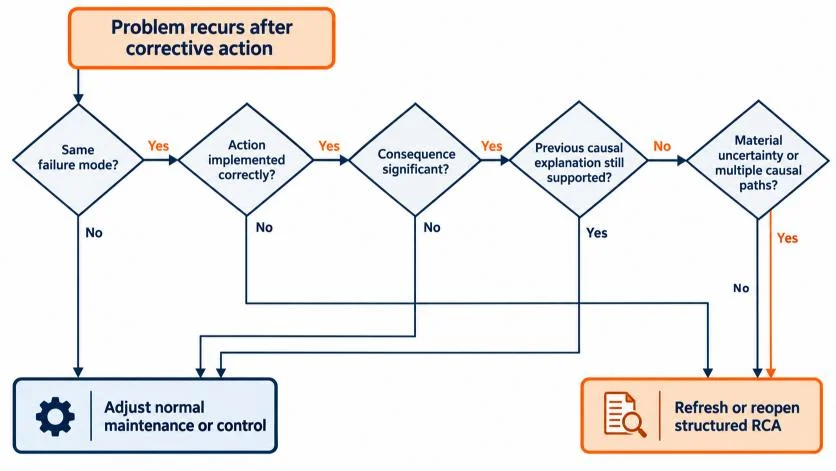
Not every recurrence requires a formal investigation. The appropriate response should reflect the consequence, frequency, uncertainty and credibility of the previous explanation.
A refreshed or reopened investigation becomes more useful when the same significant problem returns despite actions being implemented correctly, when different people disagree about the cause, when several causal paths remain plausible, or when the original investigation relied heavily on assumptions rather than evidence.
In those circumstances, revisiting the Apollo Root Cause Analysis methodology can help because the cause-and-effect logic is made visible and each material causal relationship can be tested against available evidence.
In practice, if monitored corrective actions are proving not to have resolved a significant problem, it can be useful to reopen the previous cause chart and review one or more new instances with the team. If the event is failing through the same mechanism, the additional evidence can be incorporated into the existing causal model and solution generation repeated. If the new event has a genuinely different failure mode, it may be better treated as a separate event rather than forcing it into the previous analysis.
The objective is not to rerun an RCA simply because an action failed. It is to decide whether the new evidence has undermined the previous causal explanation enough that a structured review is warranted.
Build Corrective Action Quality Into the Investigation Process
The most reliable way to improve corrective actions is to improve the investigation process that produces them.
Start with a clear problem definition. Require evidence for material causes. Link each proposed action to the cause it is intended to control. Check that the solution is practical, within the organisation’s control and unlikely to create adverse consequences. Then plan implementation and effectiveness monitoring before the action is closed.
Teams also improve through repetition. When an organisation has a clear trigger for when structured RCA should be used, people become more familiar with building causal logic, generating a wider range of solutions, testing those solutions against defined criteria and tracking whether they work.
Where teams repeatedly struggle with cause quality, action selection or effectiveness verification, a consistent investigation method can improve the quality of the process without turning every maintenance problem into a formal RCA. Root Cause Australia provides RCA training and organisational capability development for teams that need a practical and repeatable approach to significant or recurring problems.
Common Questions
Why do corrective actions fail even when they are completed?
Completion only confirms that the assigned task was carried out. The problem can still recur if the original cause was wrong or incomplete, the action did not adequately control the cause, implementation was weak, or the effectiveness review did not measure the actual problem.
How do you know whether a corrective action was effective?
Define the expected result before closure, confirm that the action was implemented as intended, monitor whether the target condition changed, and allow a review period that reflects the normal frequency of the failure or process cycle.
Should a recurring failure automatically trigger another RCA?
No. Consider the consequence, recurrence, uncertainty and whether the previous causal explanation is still credible. A fresh or reopened RCA is more useful when the problem is significant, the same failure returns despite correctly implemented actions, or the causal logic is disputed or poorly supported.
Can training or a procedure change be an effective corrective action?
Yes, when the evidence shows that knowledge, task execution or the procedure itself is a causal condition. They are not inherently weak actions, but they should be linked to a supported cause rather than selected as a generic response.
What should you do when the same problem returns after corrective action?
Review the previous problem definition, causal logic, action-to-cause link, implementation and effectiveness criteria before creating another action. Then compare the new event with the earlier failure to determine whether it is truly the same failure mode or a different path to a similar symptom.
