
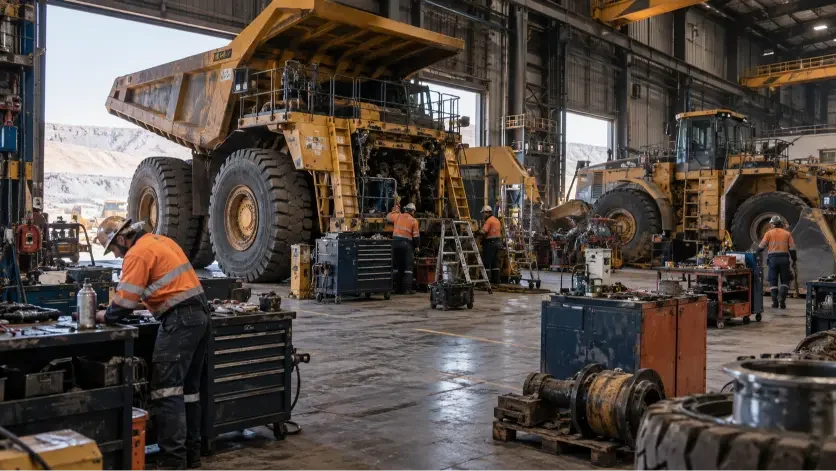
Reactive maintenance firefighting becomes a problem when urgent failures repeatedly consume the time that should be going into planning, defect elimination and reliability improvement. The team gets equipment running again, but the conditions creating the next breakdown are left in place, so the workload keeps rebuilding itself.
Reactive work is not automatically bad maintenance. Run-to-failure can be a sensible strategy for low-consequence assets where the cost and risk of failure are limited. The problem starts when reactive work becomes the operating model for equipment that matters, and the organisation loses the capacity to learn from repeated failures.
This article forms part of Root Cause Australia’s focus on RCA training and organisational capability, with an emphasis on building practical problem-solving capability inside maintenance and reliability teams.
Reactive Maintenance Firefighting: Why the Cycle Keeps Feeding Itself
On site, teams rarely describe this in formal language. They are more likely to say they are fighting fires, chasing their tail, snowed under or under the pump. The common feature is pressure. Equipment keeps returning, operations wants it back, and the maintenance team is judged on how quickly it can restore availability.
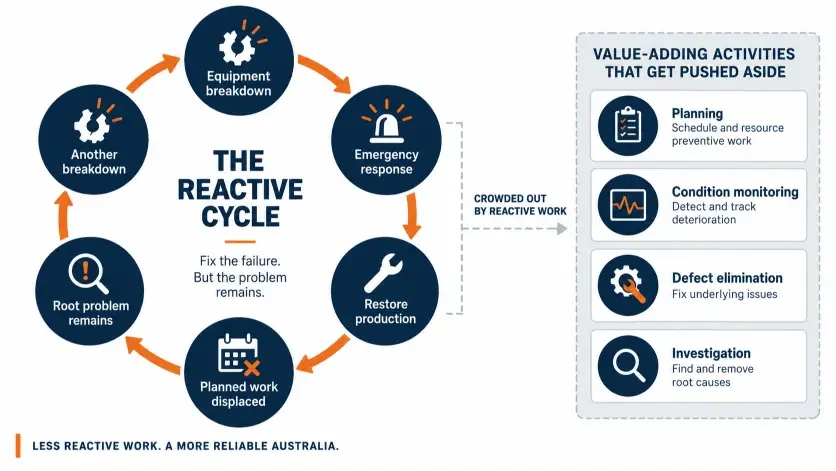
That pressure can create a reactive maintenance cycle. A breakdown occurs, the team restores the asset, planned work is displaced, smaller defects remain, and another urgent job arrives before anyone has had time to understand the previous one. As the volume of reactive work grows, the opportunity to do condition monitoring, planning, reliability analysis and defect elimination shrinks with it.
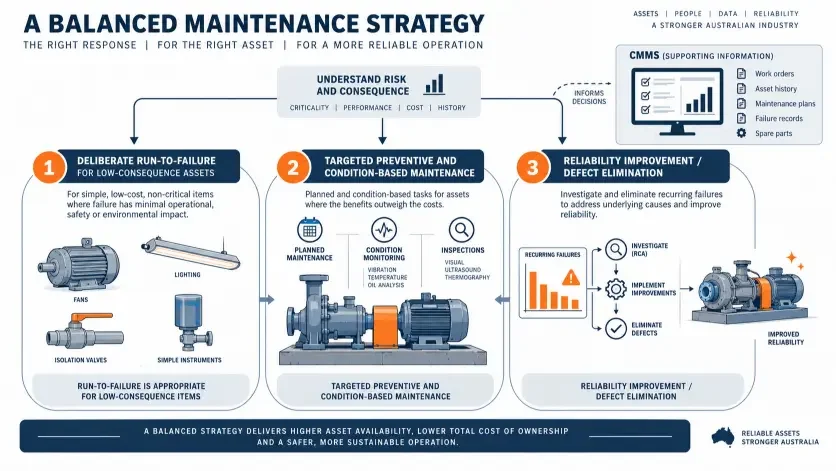
The distinction matters because the answer is not to eliminate all reactive maintenance. A sound maintenance strategy uses different approaches according to asset criticality, failure behaviour and operating context. The issue is whether the organisation is choosing reactive work deliberately or being forced into it by unresolved failures.
How to Tell When Reactive Work Has Become the Operating Model
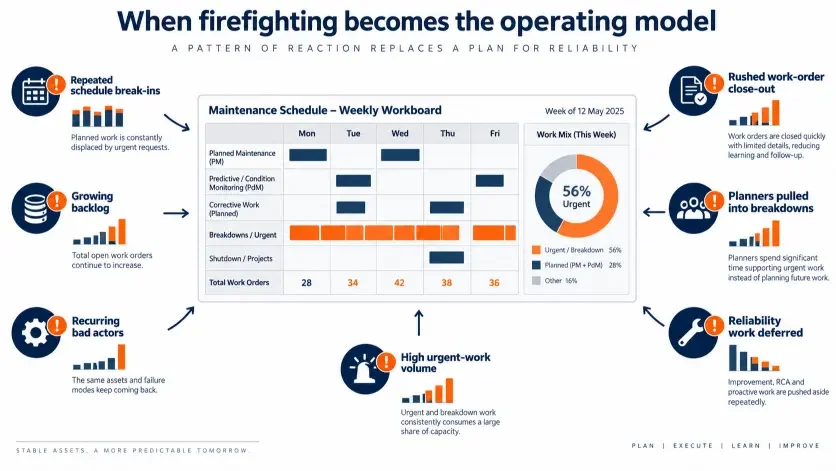
The signs usually appear in several places at once. Physical or mechanical availability starts moving in the wrong direction. The same mobile equipment keeps returning to the workshop, or the same plant areas keep generating breakdown calls. Operations begins complaining more often, maintenance spending rises, and the team starts patching defects because another urgent job is already waiting.
If a maintenance team always firefighting is the way people describe the operation, look beyond the volume of jobs and examine the pattern underneath them. Frequent schedule break-ins, growing backlog, rushed close-out notes and repeated failures on the same assets are stronger warning signs than a single busy week.
Your CMMS is useful here because it can show repeat notifications, downtime and recurring failure descriptions. It also has limits. When technicians are under pressure to move straight to the next job, the detail held in their heads often never makes it into the notification. Luke has seen sites where poor work-order descriptions made recurring problems difficult to see until the engineering team spoke directly with fitters and then used their insight to search the maintenance history more intelligently.
Why Adding More Preventive Maintenance Does Not Automatically Break the Cycle
One common response is to add people, add PM tasks or push harder on the availability target. Those actions can increase short-term capacity, but they do not automatically address the reasons the reactive workload exists.
Luke has seen sites respond to firefighting by adding people and driving the workshop harder because the immediate target was physical availability. The equipment moved out faster, but unless the recurring defects were identified and dealt with, the pressure simply returned with the next failure.
The same caution applies to preventive maintenance. More PM is not automatically better maintenance. A task only adds reliability value if it addresses a relevant failure mode at an appropriate interval or condition. Poorly targeted PM can consume the same scarce labour needed for planning, inspections, condition monitoring and engineering work.
If the goal is to move from reactive to proactive maintenance, the real question is whether the maintenance mix is changing the future failure demand. A CMMS, predictive technology or additional headcount can support that work, but none of them replaces prioritisation and failure learning.
Protect Enough Capacity to Do Work That Prevents Tomorrow’s Breakdown
If you are trying to work out how to reduce reactive maintenance, the first practical move is to create some protected capacity for work that reduces the next round of failures. This does not require a whole-site transformation.
On mobile equipment, Luke’s preferred approach is to stop treating every available service hour as an opportunity to shorten the maintenance window. If an asset has a planned service window, some of that time can be deliberately protected for identifying, planning and rectifying defects that would otherwise be pushed back into operation. A damaged mudguard, sticking ladder or another apparently minor defect may not stop production today, but leaving repeated defects unresolved can bring the asset back into the workshop sooner.
The exact split will vary by site and equipment, so it should not become a universal rule. The principle is to protect enough time for the team to inspect, plan and fix what it finds instead of measuring success only by how early the asset leaves the workshop.
Asset criticality should also shape the response. Define what genuinely warrants a schedule break-in, protect planned and scheduled maintenance where possible, and focus reliability effort on the assets and failure modes creating the greatest consequence or repeated workload.
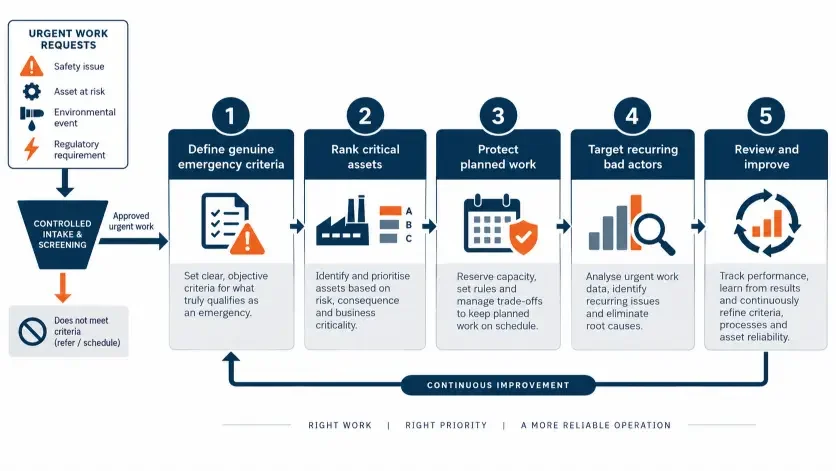
Stop Treating Every Repeat Failure as a New Job
Daily work orders can make a recurring problem look like a series of unrelated jobs. The shift occurs when the same equipment, component or failure mode keeps appearing. Repeated O-ring failures, oil contamination, bearing failures or recurring component replacements should prompt the team to ask whether it is looking at one persistent reliability problem rather than a succession of isolated repairs.
Luke’s approach is to start with the people who see the equipment every day. Fitters can often identify which components fail repeatedly, how they fail and roughly how long they last. The reliability team can then validate that knowledge against CMMS history, parts use, downtime and previous corrective actions.
That is also the point where when the same equipment keeps failing becomes a more useful question than how quickly the latest repair can be completed.
When a one-off breakdown has clearly become a recurring pattern, the Practical RCA Toolkit can help managers decide whether the problem warrants a deeper investigation and what evidence should be preserved before the next repair removes it.
Know Which Failures Deserve Structured Investigation
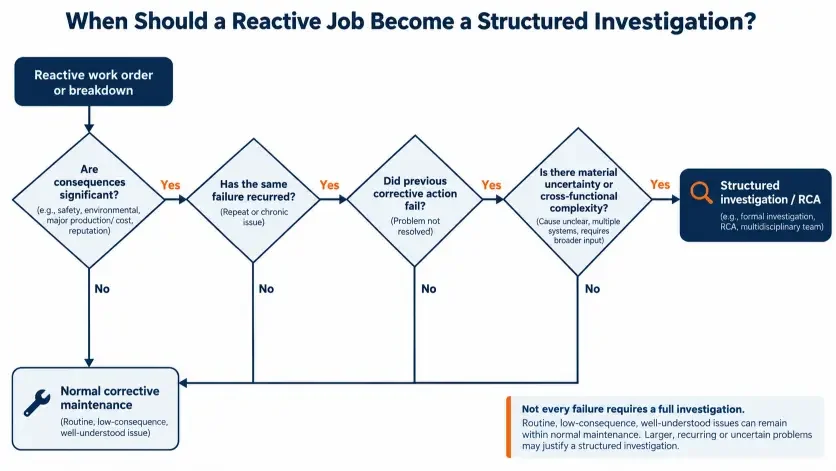
Not every reactive job needs root cause analysis. A low-consequence failure with a well-understood mechanism may be handled appropriately through normal corrective maintenance or a maintenance-strategy adjustment.
Formal investigation becomes more valuable when consequence is significant, the same failure mode keeps recurring, previous actions have failed, the mechanism remains uncertain, or several technical and organisational factors may be interacting.
Luke also cautions against accepting the first plausible explanation simply because it fits the team’s experience. In an investigation, a statement such as a bearing seized should be supported by evidence from the bearing condition and by checking the surrounding lubrication and operating conditions. The purpose is to show the logical sequence that produced the event rather than settle for a good guess.
Where the problem reaches that level, the Apollo Root Cause Analysis methodology provides a structured way to make the causal logic visible and test it against evidence.

Breaking the Cycle Is an Organisational Capability Change
A proactive maintenance culture depends on more than what happens inside the workshop. Maintenance managers, reliability engineers, planners and operations leaders each influence whether the cycle improves or continues.
Maintenance managers need to look at the broader system and ask whether the team has enough labour, tools, planning capacity and support to do more than restore equipment. Reliability engineers need to identify patterns across the fleet or plant so that the people on the floor are not expected to recognise the full business priority from individual daily jobs.
Planners need enough information to prioritise defects properly, and they need work notifications that describe what failed, how it failed and which component was involved. Supervisors and operations leaders then have to support the time required to complete planned work properly instead of treating every saved maintenance hour as an opportunity to return the asset early.
Management behaviour matters too. If the organisation celebrates only the heroic recovery from a breakdown, it can unintentionally reinforce firefighting. The quieter work of preventing the breakdown, preserving evidence, planning a defect and investigating recurrence needs organisational support as well.
A Practical First Move for a Team That Is Already Overloaded
For an overloaded team, the starting point is not a new reliability transformation program. Identify a small group of recurring failures that consume disproportionate maintenance attention, then protect enough time to investigate one worthwhile problem properly.
Use the learning from that problem to improve the maintenance tactic, work-order detail, inspection approach or escalation rule. Then check whether the same failure mode actually reduces. This creates a practical link between problem solving and day-to-day maintenance rather than another layer of administration.
Luke describes the mindset as slowing down to speed up. Once teams see that taking time to understand a significant repeat problem can create breathing room later, they become more willing to identify suitable problems for reliability review rather than simply send the equipment back out.
Where an organisation repeatedly reaches these problems but relies on a few experienced troubleshooters to solve them, building a consistent RCA capability across engineers and managers can be the next step. Training does not replace planning, maintenance strategy or action implementation, but it can give the organisation a shared method for deciding what happened, testing causes and developing evidence-based corrective actions.
Common Questions
Is reactive maintenance always a bad strategy?
No. Deliberate run-to-failure can be appropriate for low-cost, low-consequence assets. The concern is when reactive work dominates equipment where recurrence, downtime, safety or production consequences justify a more proactive response.
What is the fastest way to break a reactive maintenance cycle?
There is no universal single fix. A practical starting point is to protect some maintenance and reliability capacity, identify a small number of recurring high-impact problems, and work those problems through to implementation rather than trying to transform every process at once.
Should we add more preventive maintenance if breakdowns are increasing?
Not automatically. Review the actual failure modes first. Additional PM is useful when the task addresses a relevant failure mechanism, but unnecessary or poorly targeted PM can consume capacity without reducing reactive demand.
When should a recurring breakdown become an RCA?
Consider structured RCA when the failure has meaningful consequence, recurs in the same or similar way, remains uncertain, involves several causal paths, or continues after previous corrective actions.
References
- IBM, What Is a Maintenance Strategy?
- IBM, What is Reactive Maintenance?
- U.S. Department of Energy, Maintenance Assessment Plan
- Society for Maintenance & Reliability Professionals, The reactive maintenance cycle of doom
- IBM, What is proactive maintenance?
- MaintainX, A 90-day playbook for moving from reactive to preventive maintenance
- Reliable Magazine, How to Reduce Reactive Maintenance and Break the Firefighting Cycle
- U.S. Department of Energy, Operations and Maintenance Challenges and Solutions
