
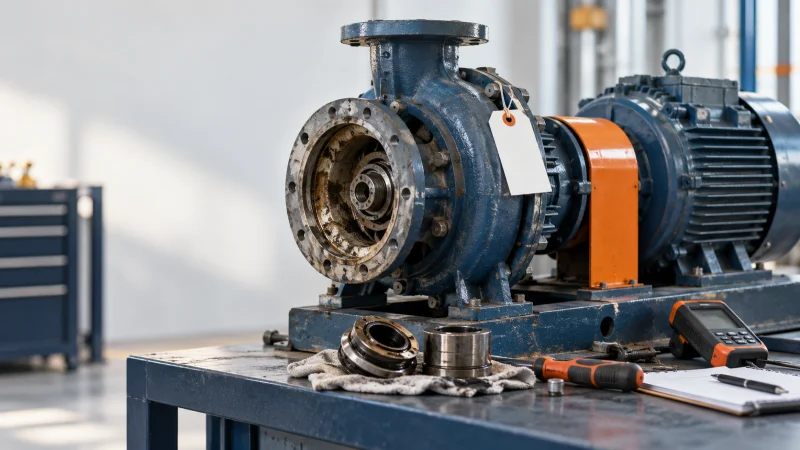
If your equipment keeps failing, the first question is not automatically, “What is the root cause?” A better starting point is to ask whether the same failure is actually happening again.
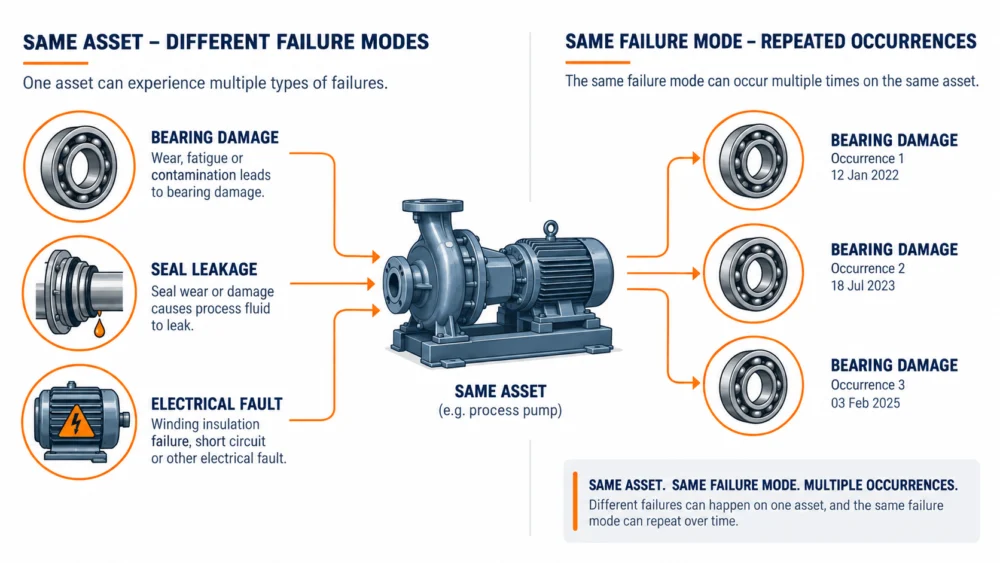
A pump can stop three times for three different reasons, and a mobile machine can return to the workshop several times without one common failure mode. The opposite is also possible: the same component can fail in the same way because the condition that caused the first failure was never changed.
The key distinction is this: repeated failures on the same asset do not always mean the same failure mode is recurring. Confirm what is actually repeating before deciding how deeply the problem needs to be investigated.
This article forms part of our RCA Methods, Tools & Comparisons pillar, which looks at how maintenance and engineering teams can match the level of investigation to the problem in front of them.
When Equipment Keeps Failing, Confirm What Is Repeating
When someone tells me a machine has “failed again”, I normally start with the maintenance history and ask what actually happened each time.
A mature CMMS may contain enough detail to show whether the same function was lost, the same component failed and the same failure mode was observed. Where those records are weak, I go back to the people who saw the failure first hand because fitters, operators and supervisors often hold detail that never made it into the work order.
Failed parts can provide another layer of evidence. On one underground mining job, a small motor or pump assembly was being replaced repeatedly. Parts use and cost were increasing, but the pattern only became clear when several discarded units were pulled from the bin and stripped down. The same corrosion was present around the lower electrical contacts on each sample.
That consistency gave us confidence that we were looking at one recurring failure mode rather than several unrelated problems. It also gave the team a much more useful question to answer: where was the moisture coming from, and what could be changed to stop it reaching the electrical contacts?
Why Replacing the Failed Part May Not Fix the Problem
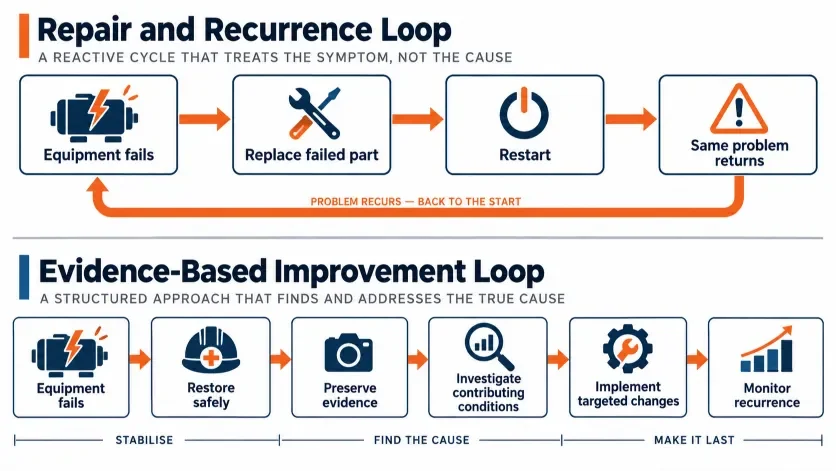
Replacing a failed part is not poor maintenance. In many operations, restoring the equipment safely and quickly is the right immediate response.
The problem starts when restoration becomes the only response, because the component that stopped the machine may be the visible result of another condition elsewhere in the system.
A hydraulic pump is a good example. If a pump fails catastrophically, it can send debris through the hydraulic system, which means cylinders, hoses, valves and other components may already have been affected before the pump is changed. Replacing only the pump can return the machine to service while secondary damage is still present.
That is the point where a one off repair can become a recurring reliability problem. If the same failure mode returns, use the Practical RCA Toolkit to help capture the evidence, define the problem and decide whether a more structured investigation is warranted.
Look for the Pattern Before You Look for the Cause
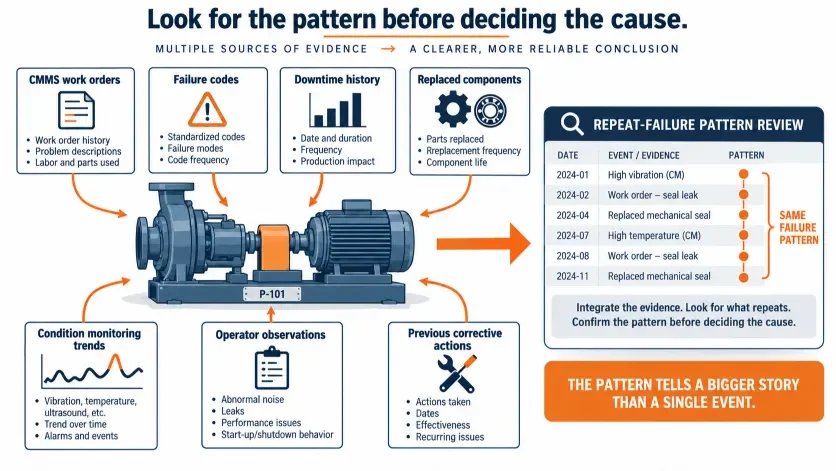
When I am given a recurring equipment failure, I usually start with the maintenance team before searching the entire CMMS.
Fitters and operators see these issues every day. If something is difficult to repair, occurs frequently or keeps creating downtime, they usually know about it, and their experience can turn a broad data search into a much more focused review.
On one underground mobile equipment fleet, repeated O ring failures were causing downtime, but it was not obvious which O rings were driving most of the problem. The fitters helped narrow the issue down by identifying the common locations, how the seals were failing and roughly how long they lasted. That gave us a much better basis for checking the maintenance history.
For larger datasets, targeted keyword searches can help isolate the relevant notifications. Searching for component names, part numbers, failure codes or repeated terms can quickly narrow thousands of records to a useful sample. This is especially helpful where a manager says the same machine keeps breaking down, because the history may reveal several different failure modes rather than one recurring event.
Useful patterns to check include:
- whether the same component is repeatedly involved;
- whether the same failure mode is being recorded;
- how long the component operates between events;
- whether similar operating conditions are present;
- whether previous corrective actions changed the outcome;
- whether downtime, frequency or cost is increasing.
This is also where bad actor analysis is useful. It can help identify which assets or failure modes keep creating the most downtime, cost or maintenance effort, so engineering attention can be directed toward the problems with the greatest value to solve.
Good notification quality matters as well. A work order that says “pump failed, bearing replaced” may be enough to close the job, but it gives an engineer very little to work with months later. Better records include what failed, how it failed, the part number, the failure code and what the fitter found during disassembly.
What Can Sit Behind Repeated Equipment Failures?
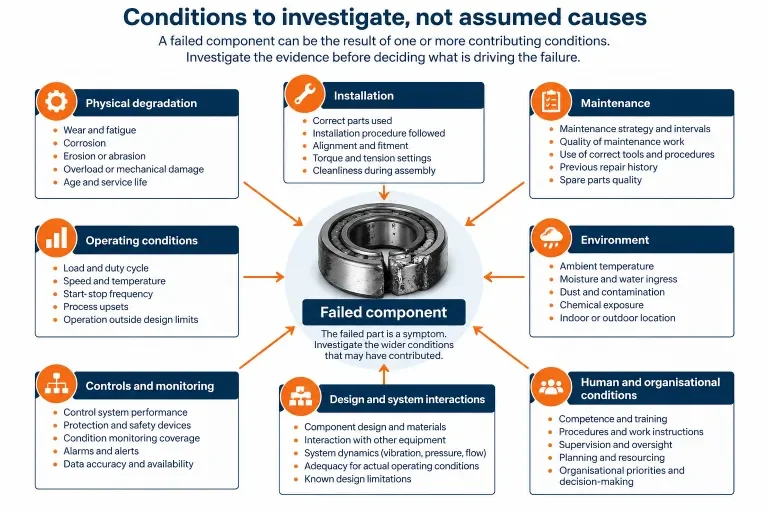
There is no fixed list of repeated equipment failure causes that can be applied across every asset. Each case still needs evidence.
Experience does, however, give you several areas worth checking beyond the visibly failed component.
Oil condition is one example. Contamination or poor oil cleanliness can damage components over time without being obvious from the final failed part. Electrical faults can be equally difficult because heat, vibration and intermittent shorts may cause a component to fail in operation but behave normally during workshop testing.
Vibration can also create damage slowly. An unbalanced shaft or worn universal joint may transmit loads into connected components, so the part that finally breaks may only be the last point in a longer chain of damage.
Other areas worth considering may include alignment, lubrication, installation quality, operating duty, environmental conditions, component suitability, control system behaviour and maintenance practice.
These are not conclusions. They are investigation paths that need to be tested against the evidence from the specific event.
Preserve the Evidence Before the Repair Removes It
Evidence can disappear quickly during a breakdown response.
A pump may be thrown in the bin, a ruptured hose discarded, oil drained, settings changed and the machine cleaned before anyone decides the event deserves a deeper review. By that stage, some of the best clues to the original condition may already be gone.
The same can happen with knowledge. A fitter may know exactly what they found, what looked unusual and what they changed, but if the notification simply says “repaired and returned to service”, that detail disappears as soon as they move to the next job.
Where a failure may need further review, try to preserve:
- photographs of the failed condition;
- the failed part or representative samples;
- part numbers and failure codes;
- alarms and operating trends;
- oil or condition monitoring results;
- operator and fitter observations;
- a record of what changed during troubleshooting and repair.
This does not mean holding up an urgent repair without good reason. It means taking enough care during recovery to make a later investigation possible.
When Is Another Repair Enough, and When Should You Investigate?
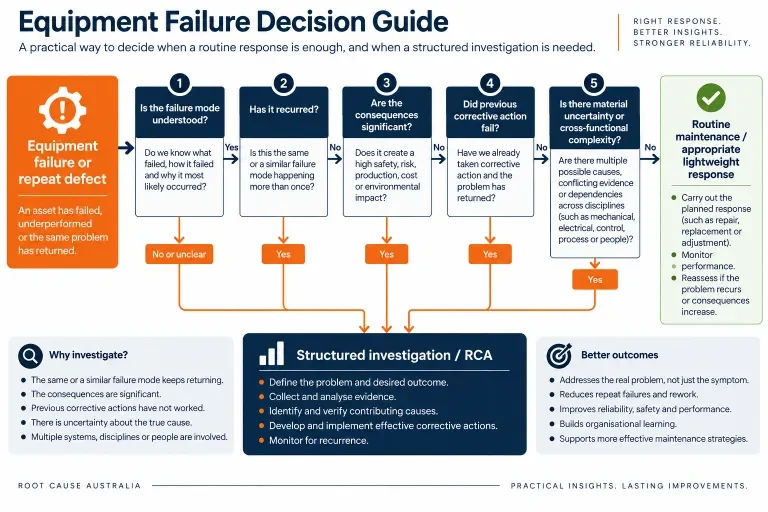
Not every equipment failure needs a formal RCA.
The trigger will vary between organisations, and in practice I look at a combination of consequence, recurrence, complexity and uncertainty.
A deeper investigation becomes more useful where a failure:
- caused or could have caused a serious safety event;
- created significant consequential damage;
- caused extended downtime or production loss;
- keeps occurring on the same asset or across a fleet;
- continues after previous corrective actions;
- has several competing explanations;
- crosses multiple teams or systems.
Frequency matters as well. A relatively small failure may still justify attention if it occurs across many machines or appears often enough to create a meaningful reliability problem.
Measures such as MTBF can show that reliability performance is deteriorating, but MTBF does not explain why. It is a signal that helps identify where attention may be needed, while the investigation still has to establish the failure mode and the conditions behind it.
The level of investigation should fit the problem. A low consequence, well understood failure may only need normal maintenance, while a repeated, costly or poorly understood problem may justify a structured Apollo Root Cause Analysis methodology so the team can test possible causes against evidence.
Move From a Plausible Cause to an Evidence Supported One
Teams often settle on a cause too early because the explanation sounds familiar.
Experience is valuable because it helps people form useful hypotheses quickly, but a hypothesis is still only a starting point until the evidence supports it.
If someone says a motor failed because the bearings seized, I want to know what supports that statement. Is there physical wear or heat damage? What was the lubricant condition? Were the oil galleries clear? Does the condition of the bearing match the proposed sequence of events?
This is where the failure mechanism matters. It explains how the damage occurred, rather than simply naming the component that was found broken.
The aim is to bring the team back to the event itself: what happened, what conditions had to exist for it to happen, and what evidence supports that view.
The Goal Is a Better Reliability Response
After the second or third recurrence of the same failure mode, the manager should stop asking only, “How quickly can we repair it?”
Better questions include:
- Is this genuinely the same failure mode?
- What did we think caused it last time?
- What evidence supported that view?
- What action did we take?
- Was the action implemented as intended?
- Did it change the condition we were trying to address?
- What evidence did we preserve this time?
- Are we repeatedly repairing something we still do not understand?
This is where a repair problem can become a defect elimination opportunity. Instead of managing the same defect repeatedly, the reliability team can focus on removing or controlling the conditions that allow it to recur.
If the same failure returns after corrective action was taken, treat that recurrence as new evidence. It should challenge what the organisation previously believed about the problem and guide the next investigation.
Common Questions
Why does the same equipment keep failing?
The same asset can fail more than once for different reasons. First confirm whether the same failure mode is recurring by comparing the failed part, symptoms, history, operating conditions and available evidence.
Does every repeat failure need a root cause analysis?
No. A formal RCA is more useful when the failure is significant, recurring, costly, hard to explain or continues after earlier corrective actions. Low consequence and well understood failures may only need normal maintenance or a lighter investigation.
What should we record after a repeat equipment failure?
Useful records include photographs, failed parts, part numbers, failure codes, alarms, operating trends, oil or condition data, fitter observations and a record of what changed during the repair.
Why can a replacement part fail again?
The replacement part may still be exposed to the condition that damaged the first one, such as contamination, vibration, heat, loading, misalignment or another system interaction.
References
- IBM: What is equipment failure and how can you prevent it?
- Reliabilityweb: Bad Actor Program
- U.S. Department of Energy: Maintenance Assessment Plan
- ASQ: Solving Chronic Quality Problems
- IBM: What Is a Root Cause Analysis?
- Siemens: What is root cause analysis?
- ASQ: The Human Side of Root Cause Analysis
